
作・為・造 Vol 1 — 視ゆ MIYU
An obi woven from 70-year-old foils that produced patterns no one planned — and no one can reproduce.
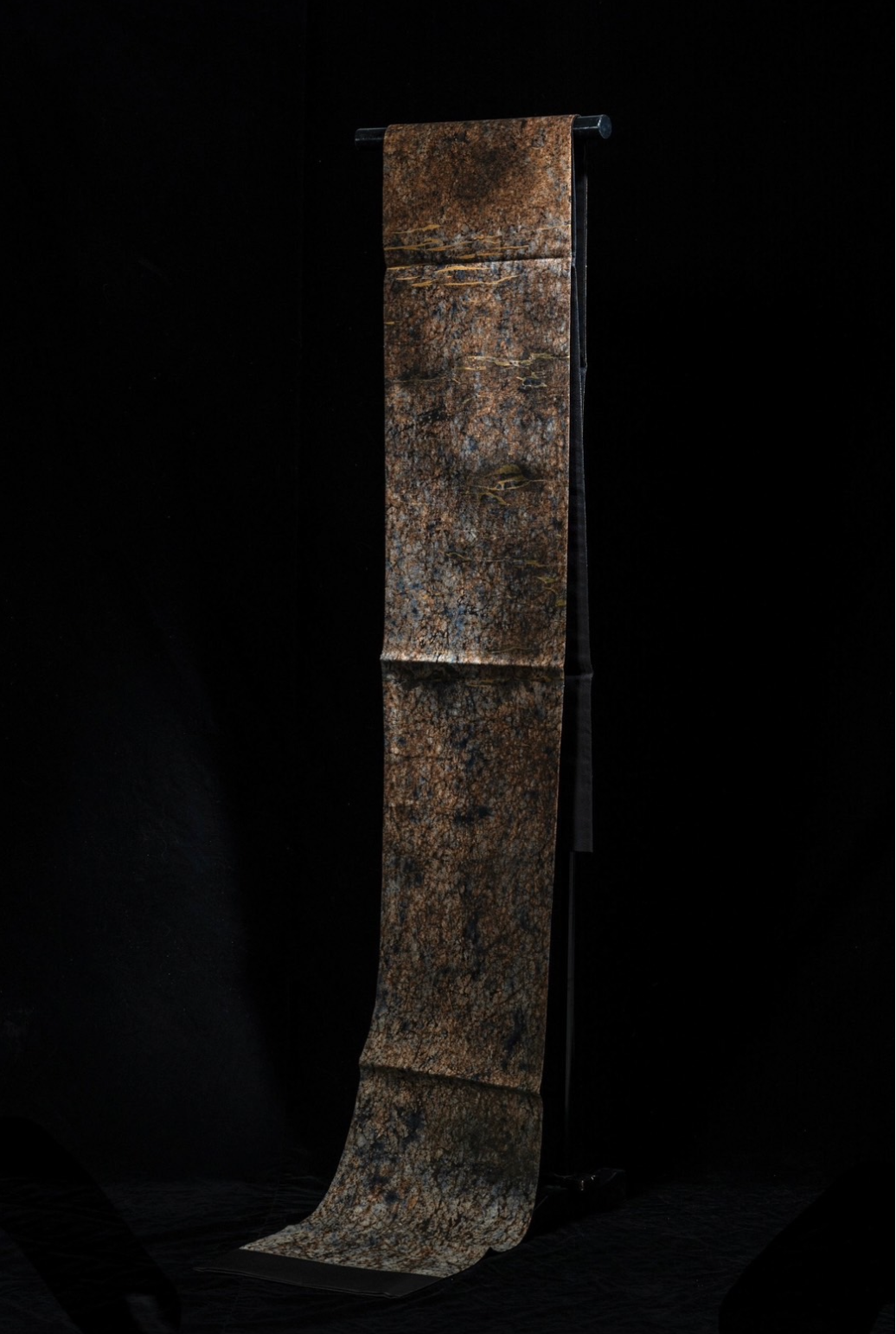
Project OverviewProject Overview For the first edition of 作・為・造, thé-En conceived, curated, and produced a single-work exhibition centered on one obi — woven using Hikihaku, an ancient technique in which lacquered foils are applied to washi paper, cut into threads finer than hair, and woven into silk. The foils used in this work are over 70 years old, dyed with indigo and persimmon tannin. What emerged — rust-gold veins, capillary-like patterns, colors that no standard dye reaction produces — was not designed. It was 作為なきもの: beyond human intention.
Background In the Japanese language, three kanji share the reading つくる — to make. 作 is to make by hand, shaping what is natural. 為 is to make through technique and method beyond human effort alone. 造 is to make through forces that exceed human will — a making that requires something beyond the maker.
作・為・造 is an event series rooted in this understanding: that the most extraordinary works are not fully authored by human hands. They are shaped through craft, carried by technique, and completed by something the maker cannot control — time, material memory, and the response of natural substances to conditions that will never repeat.
The obi produced for Vol 1 embodies all three. The foils were dyed by human hands. The weaving was carried out through accumulated technique. But the patterns that appeared — the rust, the veins, the tears in the washi visible through the weave — arrived on their own.
Process The foils used in this work were dyed in conditions that no longer exist. When indigo and persimmon met the aged mineral surface, the reaction produced colors and marks that fall outside any predictable outcome. Where the washi tore during dyeing, the tear itself became part of the pattern — woven into the silk through the Hikihaku technique, visible as texture rather than flaw.
This is the nature of working with materials that carry their own history. The craftsman does not override what the material offers. He reads it, responds to it, and weaves it as it is.
The master behind this work is one of the last practicing Hikihaku weavers — the same craftsman whose pieces are held by the Victoria and Albert Museum and who produced the Sanya Kantarovsky works that traveled to Art Basel.
He is now able to produce one new work per year. This was it.
The Exhibition 視ゆ — MIYU — draws from the ancient Japanese understanding that to see is to enter nature's domain and begin a dialogue. Not to observe from outside, but to meet what is there.
The exhibition was designed around three elements: sound, scent, and light — creating conditions in which the obi could be encountered not as an object on display, but as a presence in the room.
One piece. One room. One encounter.
Closing What makes this work unreproducible is not scarcity alone. It is the convergence of a 70-year-old material, a technique carried by one of the last living practitioners, and a natural reaction that cannot be repeated. The foils will never dye this way again. The hands that wove them are shaping one new work per year.
作・為・造 is thé-En's way of making visible what usually remains invisible — the forces within the process that no one controls, and the works that emerge because of them.