
作・為・造 Vol. 1 — 視ゆ MIYU
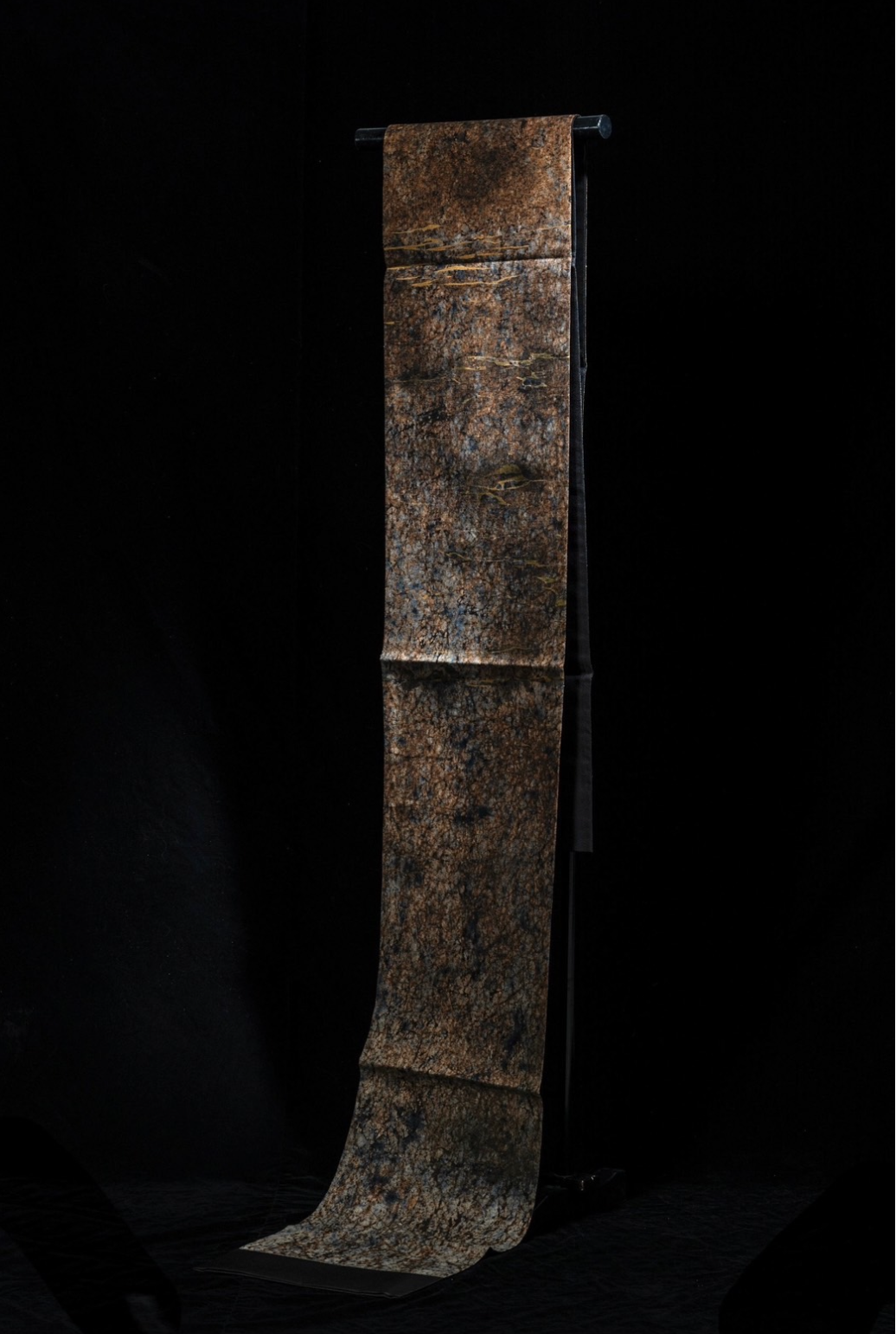
An obi woven from 70-year-old foils that produced patterns no one planned — and no one can reproduce.
This exhibition began with one work and one condition: that it could happen only once.
For the first edition of 作・為・造, thé-En conceived, curated, and produced a single-work exhibition centered on one obi woven in Hikihaku. The foils used in the piece were over 70 years old. They had been dyed with indigo and persimmon tannin under conditions that no longer exist. When these materials met the aged mineral surface of the foil, they produced rust-gold veins, capillary-like marks, and tears in the washi that no one could have designed in advance.
That is the premise of 作・為・造. In Japanese, the three kanji share the reading tsukuru — to make — but each names a different relationship to authorship. One is making by hand. One is making through technique. One is making through forces beyond the maker. This work belongs to all three. Human hands dyed the foil. Technique carried the weaving. But the most important visual events arrived on their own.
The master behind the work is one of the last practicing Hikihaku weavers — the same craftsman whose pieces are held by the Victoria and Albert Museum and who produced the Sanya Kantarovsky works later shown at Art Basel. He is now able to produce one new work per year. This was it.
The exhibition title, 視ゆ (MIYU), draws on an older understanding of seeing: not observing from a distance, but entering into relation with what is there. The room was therefore shaped not as display, but as encounter. Sound, scent, and light were composed so the obi could be felt as a presence rather than viewed as an isolated object.
What makes this work unreproducible is not scarcity alone. It is the convergence of aged material, rare technique, and a reaction that cannot be called back. The foils will never dye this way again. The work exists because no one fully controlled it.